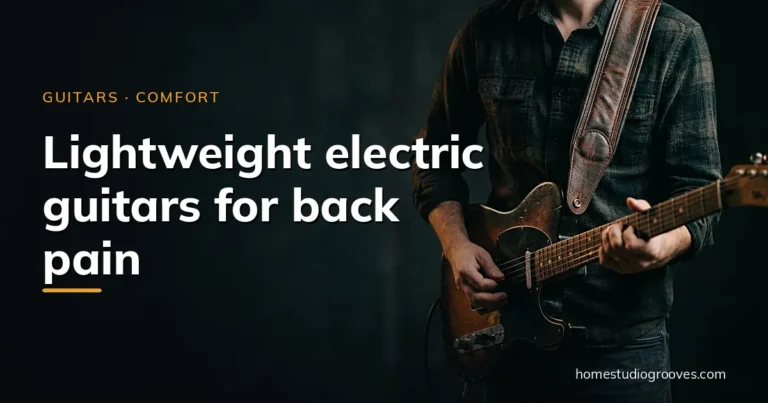

You want a Strat, a Tele or a Les Paul. You also want it under 8 lbs. Those 2 wishes are compatible, but only for certain models.
Here is which Fender and Gibson builds actually come in light, with real weights.
Key takeaways
- The Gibson SG is the lightest mainstream Gibson at roughly 6 lbs.
- The Telecaster Thinline is the lightest Fender at about 6.1 lbs to 6.75 lbs.
- Les Pauls are heavy by design. The Junior and Custom Lite are the lightest routes in.
- Squier and Epiphone versions are often lighter than the Fender and Gibson originals.
- Weight varies by a pound between 2 examples of the same model, so always ask before buying.
Quick answer
The lightest Gibson is the SG at around 6 lbs. The lightest Fender is the Telecaster Thinline at roughly 6.1 lbs to 6.75 lbs. For a Les Paul shape, the Junior at 7 lbs to 8 lbs is the lightest common option. A Standard runs 9 lbs to 11 lbs.
Fender and Gibson models by weight
Sorted lightest first. Figures are typical, not guaranteed.
| Model | Brand | Typical weight | Why |
|---|---|---|---|
| SG Standard | Gibson | 6.0 to 7.0 lbs | Thin slab body |
| Telecaster Thinline | Fender | 6.1 to 6.75 lbs | Chambered with f hole |
| ES-339 | Gibson | 6.8 lbs | Small semi hollow |
| Duo Sonic | Fender | 6.5 to 7.5 lbs | Short scale, small body |
| Mustang | Fender | 7.0 to 8.0 lbs | Short scale |
| Les Paul Junior | Gibson | 7.0 to 8.0 lbs | Flat top, no maple cap |
| Les Paul Custom Lite | Gibson | 7.6 to 7.9 lbs | Thinner body |
| Telecaster | Fender | 7.0 to 8.0 lbs | Alder or ash, flat body |
| Stratocaster | Fender | 7.3 to 8.5 lbs | Contoured alder body |
| ES-335 | Gibson | 7.0 to 8.1 lbs | Semi hollow |
| Les Paul Studio | Gibson | 8.0 to 9.0 lbs | Modern weight relief |
| Les Paul Standard | Gibson | 9.0 to 11.0 lbs | Solid mahogany, maple cap |
The lightest Gibson guitars
Gibson has a reputation for heavy instruments, which is mostly about the Les Paul.
SG Standard, roughly 6 lbs
The lightest Gibson you can walk into a shop and buy. Same mahogany as a Les Paul, but the body is about 1.5 inches thick instead of 2.5.
The catch is balance. SGs are the classic neck dive guitar, so budget for a wide strap. That issue is covered in the guide to lightweight electric guitars for back pain.
Les Paul Junior, 7 lbs to 8 lbs
The lightest way into a real Les Paul shape. The Junior drops the carved maple cap and uses a flat mahogany slab.
You get 1 P90 pickup instead of 2 humbuckers. Simpler, and 2 lbs lighter than a Standard.
ES-339, about 6.8 lbs
A smaller ES-335. Same semi hollow construction in a body closer to a Les Paul in size, which makes it easier to handle sitting down.
Pro tip
Epiphone versions are frequently lighter than the Gibson equivalents, because they use less dense wood. An Epiphone SG Special runs about 6.5 lbs to 7.5 lbs at a fraction of the price.
The lightest Fender guitars
Fenders sit in a narrower band than Gibsons. Most land between 7 lbs and 8.5 lbs, with 1 clear outlier.
Telecaster Thinline, 6.1 lbs to 6.75 lbs
The lightest Fender in normal production. Chambers routed into the ash body and an f hole cut into the top.
The Vintera II 60s Thinline measures around 6.1 lbs to 6.75 lbs. Older American Vintage reissues run heavier at roughly 8.6 lbs, so the year matters.
Duo Sonic and Mustang, 6.5 lbs to 8 lbs
Short scale and physically smaller. The 24 inch scale suits smaller hands and the reduced body size cuts weight.
Stratocaster and Telecaster, 7 lbs to 8.5 lbs
Wood choice decides it. A roasted pine American Professional II Telecaster weighs about 7.2 lbs, while a mahogany Jim Root Stratocaster hits 8.8 lbs.
If you want a light Strat, look for alder or basswood rather than ash. Players generally treat anything under 7.5 lbs as a light Strat.
Why Les Pauls are so heavy
3 design decisions stack up, and none of them were about weight.
- Solid mahogany body at roughly 40 lbs per cubic foot, one of the denser tonewoods.
- A carved maple cap on top, denser still at about 45.
- A thick single cutaway body near 2.5 inches, so there is simply more wood.
Gibson has tried to solve this repeatedly, with weight relief holes, chambering and modern elliptical pockets. Whether those change the tone is covered in do lightweight guitars sound worse.
Current Standards went back to solid construction in 2019, which is why new ones run 9 lbs to 10 lbs again.
Budget brands are often lighter
This surprises people. Squier and Epiphone models frequently weigh less than the instruments they copy.
| Budget model | Weight | Original | Weight |
|---|---|---|---|
| Squier Telecaster | 6.5 lbs | Fender Telecaster | 7.0 to 8.0 lbs |
| Squier Tele Thinline | 6.6 lbs | Fender Thinline | 6.1 to 8.6 lbs |
| Epiphone SG Special | 6.5 to 7.5 lbs | Gibson SG | 6.0 to 7.0 lbs |
| Epiphone Casino | 6.6 lbs | Gibson ES-335 | 7.0 to 8.1 lbs |
The reason is less dense wood, often poplar or basswood instead of alder or mahogany. That saves weight, and the tonal difference is smaller than the price gap suggests.
Pro tip
Not every budget model is lighter. A Squier Classic Vibe 70s Jaguar can reach 10.6 lbs, which is heavier than most Les Pauls. Check the individual instrument rather than assuming.
How to find a light example
Weight varies enough within a model that the specific instrument matters more than the spec sheet.
- Ask the dealer to weigh it. Larger retailers list individual weights and will confirm on request.
- Check the body wood in the listing. Alder, basswood and poplar beat mahogany and ash.
- Prefer thinner bodies. Thinline, semi hollow and slab bodies all start lighter.
- Look at the year for Gibsons, since construction changed several times.
- Buy in person where possible. A pound of difference is obvious the moment you pick it up.
Who should look elsewhere
Brand loyalty has a weight cost. If the number matters more than the badge, other makers go lighter.
- Anyone needing under 6 lbs. No standard Fender or Gibson gets there. Headless builds do.
- Players with real shoulder injuries. A 6 lb SG that dives may still hurt.
- Modern players. An Ibanez S series is lighter than any comparable Fender or Gibson.
How these weights were gathered
Weights come from manufacturer specifications and retailer listings for individual instruments. I cross checked those against figures posted by owners who weighed their own guitars.
Ranges are shown where variation is genuine, which is most of the time. A single number would be misleading for wood.
Frequently asked questions
What is the lightest Fender guitar?
The Telecaster Thinline at roughly 6.1 lbs to 6.75 lbs, thanks to its chambered body and f hole. The Duo Sonic is next at about 6.5 lbs because of its short scale and smaller body.
What is the lightest Gibson guitar?
The SG Standard at around 6 lbs. Its body is roughly 1.5 inches thick against 2.5 inches on a Les Paul, which removes a large amount of mahogany.
What is the lightest Les Paul?
The Les Paul Junior at 7 lbs to 8 lbs, since it uses a flat mahogany body with no carved maple cap. The Custom Lite is similar at about 7.6 lbs to 7.9 lbs but harder to find.
How much does a Stratocaster weigh?
Between 7.3 lbs and 8.5 lbs depending on the body wood. Alder examples sit at the lighter end, while ash and mahogany models such as the Jim Root signature reach 8.8 lbs.
Is a Telecaster lighter than a Stratocaster?
Usually by a small margin. Telecasters run about 7 lbs to 8 lbs and Stratocasters 7.3 lbs to 8.5 lbs. The individual piece of wood matters more than the model.
Are Epiphone guitars lighter than Gibson?
Often, because they use less dense woods such as poplar. An Epiphone Casino weighs about 6.6 lbs against roughly 7 lbs to 8 lbs for a Gibson ES-335.
Where to go next
For the lightest Fender and Gibson models, the SG and the Telecaster Thinline are the 2 to try first. Both sit near 6 lbs without leaving the traditional shapes behind.
- Compare everything: the lightest electric guitars ranked
- Tone worries: do lightweight guitars sound worse
- See the full picks: 8 lightweight electric guitars worth buying
- If playing hurts: lightweight electric guitars for back pain
- Record it: how to record electric guitar without an amp
- Capture your playing: how to record yourself playing guitar
- Set up your input: best audio interfaces under $200