
I remember back in my beginner stages, I always wondered if the pros were using analog or digital gear. It’s one of those questions every new producer goes through eventually. You hear a mix that sounds warm and wide and alive, and you start wondering what’s behind it.
Then I found out there are analog-style plugins that emulate real hardware. That was a relief, honestly. The physical gear costs a fortune. A real SSL console can run six figures. The plugin version costs a few hundred at most, and the gap in sound quality is smaller than most people expect.
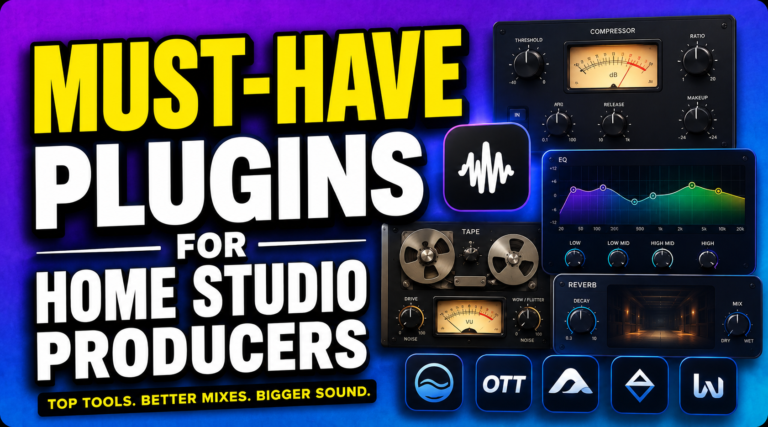
But that gap is still real. And knowing when it matters, and when it doesn’t, is what this article is about. If you’re still building out your core plugin setup, I’d suggest starting with my full breakdown of must-have plugins for home studio producers first, as this article assumes you already have the basics covered.
Key Takeaways
- Analog-style plugins have gotten close enough that even experienced engineers fail blind A/B tests against the hardware.
- The biggest advantage of real analog gear in 2026 is workflow and feel, not necessarily sound.
- Digital-native plugins like Serum and FabFilter are not trying to sound like hardware. They’re a different tool, not a compromise.
- For most home studio producers, analog-style plugins are the right call. The exceptions are niche, not the norm.
- Genre matters. Jazz and classical benefit most from analog character. Modern pop and electronic production often work better with clean digital tools.
What “Analog-Style Plugin” Actually Means
Analog-style plugins, often called hardware emulations, are digital recreations of physical gear. A compressor like the 1176, an EQ like the Pultec, a tape machine like the Studer A800. Companies like Universal Audio, Waves, Plugin Alliance, and Softube spend years reverse-engineering the nonlinear behavior of the original circuits and modeling it in software.
The result is a plugin that tries to sound like the real thing. Not just the frequency curve, but the harmonic distortion, the saturation, the way it responds when you push it hard. That behavior is what gives analog gear its character, and it’s what analog-style plugins are trying to recreate.
Digital-native plugins don’t try to do any of that. Serum, FabFilter Pro-Q 4, Valhalla Supermassive. These tools were designed for the digital domain from day one. They’re clean, precise, and linear in ways that analog hardware physically cannot be. That’s not a weakness. It’s a different design goal.
The comparison isn’t really analog vs digital. It’s character vs precision. Both have a place in a mix. The question is which one you need for a given task.
How Close Do Analog Plugins Sound to Real Hardware?
Closer than most people think. David Bendeth, a producer behind many major rock records, shared a story about betting he could tell the difference between a half-inch tape machine and Pro Tools. He listened to ten blind playbacks and got seven wrong. That test didn’t prove plugins are identical to hardware. It proved that the gap is narrow enough to fool experienced ears under controlled conditions.
Universal Audio consistently comes up as the most accurate emulator. Their Variable Mu compressor plugin, modeled with direct involvement from Manley, runs at around 95% accuracy according to engineers who own both. The Massive Passive EQ sits around 90%. The remaining 10% difference often has as much to do with the specific hardware unit, tube age, and room temperature as it does with the plugin itself. Tube gear isn’t perfectly consistent even between two units of the same model.
Where emulations tend to fall short is in what engineers call “definition in the stereo field.” Joel Wanasek, who mixed entirely in the box for 20 years using Waves SSL plugins, noticed a softness and lack of width when he compared his mixes against engineers working on real SSL hardware. It wasn’t until he ran audio through an actual SSL 4K channel strip at unity gain, doing nothing but passing the signal through the hardware, that he heard the difference clearly.
That’s a subtle thing. Most listeners won’t hear it. But for engineers finishing high-budget records, it’s real.
Why Producers Still Buy Hardware (It’s Not Just About the Sound)
Bendeth describes his SSL console the way a pianist describes a good instrument. It’s not just about what it does to the audio. It’s about how it feels to use. Riding faders with your hands, reacting to the music physically, making instinctive adjustments without touching a mouse. That workflow changes how you mix.
There’s something to that. Staring at a screen for eight hours and chasing faders with a trackpad is a different experience from having a hundred physical controls in front of you. Some engineers make better decisions faster when the interface is tactile. That’s a legitimate reason to invest in hardware, though it’s separate from the question of whether the hardware sounds better.
For home studio producers, that argument mostly doesn’t apply. A full analog console takes up a room. It requires maintenance, calibration, and a patchbay that costs more than most home studio budgets. The workflow advantage is real, but it’s not accessible at that price point.
When Analog-Style Plugins Are the Right Choice
For most tasks in a home studio, analog-style emulations cover the gap well enough that the difference is academic. Here’s where I consistently reach for them.
Compression
This is where analog-style plugins earn their place. The 1176, LA-2A, and Fairchild compressors have character that clean digital compressors don’t replicate. The way an 1176 reacts when all four ratio buttons are pressed simultaneously, a trick called All Buttons In, produces a pumping distortion that sounds like nothing else. UAD’s emulation of that behavior is accurate enough that most producers can’t tell the difference in a finished mix.
For transparent compression, a clean digital compressor is the better tool. For character compression, analog-style emulation is worth it. I cover both sides in more detail in my guide to the best compressor plugins for transparent mixing.
Tape Saturation
Running a mix through a tape machine plugin adds subtle harmonic distortion, frequency shaping, and gentle compression that makes individual elements sit together better. It’s one of the most effective things I do on a mix bus when a track feels too clinical. Plugins like Waves Tape, UAD Studer A800, and the free IK Multimedia tape emulations all do this convincingly. If you want to go deeper on how saturation fits into a mix, my saturation plugin tips guide covers the practical side of it.
Vintage EQ Character
A Pultec EQ plugin does something that FabFilter cannot. It adds a slight resonance and phase shift that colors the sound in a musical way. That’s not a flaw in the design. It’s the reason engineers reach for it on specific instruments. Analog-style EQ plugins are the right tool when you want EQ that adds character, not just frequency correction. For purely corrective work, I switch to a clean digital EQ every time. The EQ plugins that pros actually use covers both categories if you’re deciding between them.
UAD 1176 Classic Limiter Collection
The most accurate 1176 emulation available. Covers the Rev A through Rev E models with distinct character differences between each. The All Buttons In mode is accurately modeled. Works best on vocals, drums, and bass.
- Best for: Character compression on individual tracks
- Limitation: Requires UAD hardware or UAD Spark subscription
IK Multimedia Tape Machine Collection (Free Models)
IK offers several tape machine emulations at no cost through their Custom Shop. The free models cover basic tape saturation convincingly. Worth installing before spending money on UAD tape plugins.
- Best for: Mix bus warmth, drum bus saturation
- Limitation: Requires IK Multimedia account and Custom Shop app
When Digital-Native Plugins Are the Better Tool
There are specific tasks where reaching for an analog emulation is the wrong call, not because emulations are bad, but because the job needs something different.
Surgical EQ Work
Removing a resonance at 2.3kHz, taming a harsh consonant in a vocal, cutting a room mode from a bass track. These are precision jobs. A Pultec adds color while it cuts. FabFilter Pro-Q 4 removes exactly what you tell it to and leaves everything else untouched. For corrective EQ, a clean digital EQ is faster and more accurate, full stop.
Synthesis
Serum, Vital, and Massive are not trying to sound like anything analog. They produce sounds that physical synthesizers cannot make. The wavetable morphing in Serum, the spectral warping in Vital. These are digital-native capabilities. If you’re just getting started with free options, my best free VST plugins for beginners covers the ones I’d actually recommend to someone starting from scratch.
Reverb and Delay in Modern Genres
Analog spring and plate reverbs have character, but modern production often calls for the kind of spatial control you only get with digital reverb design. The ability to freeze a tail, dial in an exact pre-delay, or run a shimmer reverb that no physical plate could produce. I use Valhalla Supermassive on ambient and electronic work specifically because it does things hardware cannot. If you’re unsure which effect fits a given part, my delay vs reverb guide helps clarify when to reach for each one. And if you’re specifically looking for reverb recommendations, the top reverb plugins that actually sound good covers both analog-style and digital options side by side.
Which One to Use by Genre
Genre changes the answer more than most producers expect. Here’s how I think about it.
| Genre | Analog Emulation | Digital Native |
|---|---|---|
| Jazz / Classical | Strong fit. Warmth and natural compression behavior suit acoustic instruments. | Can sound clinical on acoustic sources. |
| Rock / Blues | Strong fit. Tape saturation and vintage compression add appropriate grit. | Usable, but often needs analog character added back in post. |
| Modern Pop | Selective use. Compression character works. Tape saturation can muddy the low end. | Strong fit. Clean, controlled low end and precise EQ work well. |
| Hip-Hop / Trap | Selective use. Vintage compressors work on drums and vocals. Avoid heavy tape saturation on 808s. | Strong fit for synthesis and drum processing. |
| Electronic / Ambient | Selective use. Tape and reverb emulations add texture. Not suited for the core signal chain. | Strong fit. Digital tools handle the precision and space this genre needs. |
How to Get an Analog Sound Without Emulation Plugins
There’s a third option worth knowing about. If you want a genuinely analog sound but aren’t ready to spend on emulation plugins, recorded instrument samples give you that quality for free. Those samples were captured through real microphones, real preamps, and real acoustic spaces. The analog character is already baked in because it was recorded with physical gear.
Layering a sampled acoustic guitar or a real drum loop underneath a programmed track adds organic texture that no plugin fully replicates. A small amount of saturation or gentle distortion on top of those samples pushes the sound further without overdoing it. This is something I often advise producers who are still building their plugin libraries. The free IVGI saturation plugin by Klanghelm is a solid starting point for this, zero cost and genuinely useful.
The SSL Virtual Tape Machine plugin costs a fraction of the physical hardware and gets close enough in a home studio context that the remaining gap rarely shows up in a finished mix. That’s the realistic case for emulation in 2026.
Analog Plugins vs Hardware: The Real Cost Difference
Physical analog gear is expensive in ways that compound. A real 1176 costs over $3,000 new. It requires a rack, a patchbay, cables, power conditioning, and regular maintenance. A UAD 1176 plugin costs around $200 and installs in five minutes. The SSL 4000 G channel strip, a console module that costs $1,500 per channel in hardware, is available as a plugin bundle for under $100 during sales.
For a home studio producer building a workflow from scratch, the math is not close. Analog-style plugins give you access to the character of gear that would otherwise cost tens of thousands of dollars. The remaining quality gap is smaller than the quality gap between a producer who spent that budget on hardware and one who spent it on room treatment and monitoring.
If you’re looking at buying a broader collection at once, it’s worth checking my breakdown of plugin bundles worth the money in 2026 before buying individual plugins at full price. Some of the analog emulation bundles in particular represent good value.
The Bottom Line
Analog-style plugins are worth it for most home studio producers. They’re not identical to hardware, but they’re close enough that the difference stops mattering once your room, monitoring, and fundamentals are solid. Digital-native plugins are the better choice for precision work, synthesis, and modern electronic production. The producers who get this wrong are the ones who treat it as an either/or decision. Most good mixes use both.
Frequently Asked Questions
Close, but not identical. The gap is small enough that most listeners won’t hear it in a finished mix, though engineers with both often notice subtle differences in stereo width and definition.
For compression and tape saturation, often yes. For EQ correction and synthesis, free digital tools frequently do the job better.
Universal Audio is the most consistent. Plugin Alliance and Softube also produce accurate emulations, particularly of SSL and vintage compressor hardware.
No. Overusing tape saturation and vintage compression muddies a mix quickly. Use them where you want character, and keep clean digital tools where you need precision.
They help. Acoustic genres benefit from the natural compression and warmth that analog emulations add, especially on room mics and mix buses.
Yes. Neural DSP and similar tools are starting to model hardware behavior more accurately than traditional circuit modeling. That gap will narrow further over the next few years.
Yes. Recorded instrument samples, subtle saturation from free plugins like IVGI, and careful gain staging can get you much of the way there at no cost.
Wrapping Up
It’s not as common anymore to want a genuinely analog sound for its own sake. A lot of producers who have been in the game a long time still chase that clean, warm studio sound you get with real analog gear. That preference is legitimate. But it’s also specific.
Genres like jazz and classical still benefit from that realistic analog character in ways that matter. Modern pop can get away with fully digital signal chains and often sounds better for it.
For producers without physical gear, adding recorded instrument samples into a mix is one of the most underrated moves available. Those samples carry real analog character because they were recorded through real equipment. Coupling that with a light touch of saturation or distortion gets you closer to the sound you’re after without spending anything.
The answer to analog vs digital in 2026 is almost always both, used where each one makes sense.